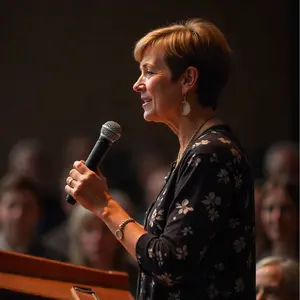
outputGenerated with EulogyAI using AI
Family, friends, colleagues, neighbours—
thank you for standing with us today, under open sky, to honour and lay to rest my twin sister, Sarah Jane O’Neill—our Sadie.
We were born on March 3, 1980, and from the first breath, we travelled in tandem.
Two cribs, two backpacks, two sets of skates.
And a language of our own that never quite needed words.
Today I speak as her sister,
but also as one of the many people whose lives were steadied by her counsel,
lifted by her humour,
and changed by her conviction that education, fairness, and community are worth our best energy.
Sadie was Ottawa-born and Ottawa-raised, and she carried this city in her voice.
English and French braided together, as natural to her as breathing.
She was a Francophile through and through—delighted by language, its music, its precision, its power to welcome.
She earned her education degree at the University of Ottawa,
and from that point forward she seemed to walk with purpose you could measure.
An elementary French immersion teacher.
A literacy advocate.
A girls’ soccer coach who brought cones, spare mitts, and snacks arranged with military calm.
An organizer of school book drives who treated every gently used paperback as if it were a passport in a child’s hand.
She married Marc Dubois, whose steadiness matched hers in all the right ways.
Together they built a home full of shared meals, inside jokes, and the happy clatter of family.
She was and is the proud mom of Émilie and Noah.
You were her north star, the quiet reason behind countless late nights preparing lessons,
the extra scarf in a backpack,
the reminder that love is both feeling and daily work.
To Eileen and Patrick, our parents—
you gave us roots and the expectation that we use them well.
Sadie lived that expectation with an almost ceremonial care.
She believed in doing things properly,
and she believed in doing them with heart.
People like to sort the world into tidy boxes—serious or funny, firm or kind.
Sadie refused the choice.
She was steadfast and organized,
principled and fiercely loyal,
and she was also funny—dry and quick, with timing improved by years of classroom practice.
“Kindness with backbone,” she would say, and then she would prove that it wasn’t a contradiction.
Some memories arrive in flashes; others settle like a steady light.
My favourite memory is of early morning canoe paddles at the Muskoka cottage.
Mist rising.
Coffee in dented thermoses.
Paddles moving in that quiet whoosh that makes time slow down.
We didn’t talk about everything.
We didn’t need to.
But what we did say, we meant.
Plans for the year.
Stories of students who had surprised us both with their grit.
Family news folded into laughter.
Every now and then she would pause, point with the paddle at a loon, and say, “See? The day already knows where it’s going.”
She had a way of reminding me that calm is not a mood; it’s a practice.
If you want to know who someone is, watch them when nobody’s looking.
Watch them on Saturdays:
CBC Radio murmuring in the kitchen,
crossword pencilled in with a neatness that would make a typesetter proud,
a list for the week written on a sticky note that somehow never fell off the fridge.
Watch them in January:
snowshoes leaning against the door,
toques she had knitted piled in a bag, ready for the winter drive so that strangers would be “a little warmer, and a little less alone.”
Watch them on a Tuesday after school:
her car a travelling library,
paperbacks for the hallway shelves, because if a child reached for a story and found one,
then a corner of the world tilted in a better direction.
Inside the classroom, Sadie was the person you wanted in a storm.
She made each student feel seen—truly seen, not as a list of marks or a line in a register.
She greeted them in French, and if the morning had been hard, she tucked in a joke, a small challenge, a fresh start.
Her pep talks moved easily between languages—“Tu es capable. You can do this.”—
and they worked because she knew the work herself.
She was rigorous without harshness, generous without softness becoming an excuse.
Fairness to her meant meeting a child where they were, and then walking with them farther than they believed they could go.
Beyond the classroom, she coached.
She organized.
She repaired what could be fixed and replaced what could not, in budgets and bicycles and people’s spirits.
She held standards, not grudges.
If she ever raised her voice, it was to be heard for the purpose of making room for someone quieter.
Her loyalty was not loud, but it was unshakeable.
We will miss her bilingual pep talks.
We will miss her calm counsel when the weather, literal or figurative, turned.
We will miss the grace with which she returned emails at midnight and still remembered to ask in the morning, “Have you eaten?”
We will miss the way she took a hall of a hundred children and, with a tone only teachers possess, returned it to working order.
We will miss her laughter that began with the eyes and then arrived, unhurried, in a line she had been saving.
Émilie and Noah,
your mother’s love is stamped into your days in ways you will keep discovering.
In the labelled mittens.
In the books she left dog-eared at the best parts.
In the way your friends felt welcome in your kitchen.
In the habits she grew in you—curiosity, fairness, and a small supply kit ready for anything.
She believed that being brave starts small—asking a question, standing alongside someone left out.
Carry that forward, in your own way, at your own pace.
She trusted you.
We trust you.
And we are with you.
Marc,
partners navigate not only the planned route but the detours, the flooded roads, the quiet Sundays.
Thank you for the love and patience that filled your home.
There was a particular ease between you and Sadie—two practical minds that still found time to be silly.
That ease does not end here.
It will take new forms,
and we will help you protect it.
To her colleagues and students gathered here in person and in spirit,
thank you for giving meaning to her life’s work.
She believed that classrooms are neighbourhoods,
and she treated the staff room like a commons where ideas should be exchanged, sharpened, and put to use.
She treasured your camaraderie,
your good arguments,
your shared belief that public education is an act of collective hope.
Sadie did not confuse busyness with purpose.
She kept lists, yes.
But the lists were pointed toward something beyond themselves—toward service.
She believed in education for all.
She believed in fairness that reached beyond slogans.
She believed in humour in hard times—not to avoid the truth, but to make space to bear it.
She believed that community is not a feeling we wait for; it is a set of actions we repeat.
Those actions will continue.
Our family is arranging a memorial bench at her school,
a place where students and staff can sit,
read a page or two,
and maybe hear, if the wind is right, her voice insisting that you can, in fact, finish the chapter.
Friends who wish to do something concrete may contribute to a literacy fund in her name,
a living extension of the book drives she loved.
If you’re not sure where to begin,
start with a child and a story.
That was her method,
and it worked.
As her twin, I carry a lifetime of small evidence that she was who she said she was.
When we were little and I was sure I’d lost my way in a crowd,
her hand would find mine.
When we were older and I’d lost my way in less visible ways,
she would make tea,
clear a patch of table,
and begin with, “Tell me from the beginning.”
She did not fix everything.
She did something harder.
She stayed.
Standing here, I can almost see the lake at dawn.
Mist rising.
A canoe nudging the shoreline.
Two thermoses, still warm.
But even as I see it, I know the task before us is not to go back.
It is to keep what was essential and carry it forward—
to keep the steadiness,
the backbone in kindness,
the habit of service,
the insistence that every person be seen.
We lay Sadie to rest today at forty-six years old.
Too soon, we all feel it.
But in the measure that matters—how she used her days—she lived fully and well.
She left classrooms changed,
teams braver,
colleagues strengthened,
a family knit together with durable thread.
When the season turns and snow returns,
if you pass someone who looks cold,
remember her toques and her winter drives,
and let that memory become an action.
When a child stumbles over a sentence,
remember her patient hand guiding each sound,
and let that patience shape your reply.
When life grows complicated,
remember her laughter,
and let that laughter clear a path.
Sadie,
sister,
teacher,
coach,
wife,
mother,
daughter,
friend—
thank you for the fairness you practised,
the education you championed,
the humour you lent to hard days,
the service you rendered without spectacle.
We release you with love.
We keep you with gratitude.
And we promise, together, to continue the work you began—
one student,
one neighbour,
one book,
one quiet act of courage at a time.
Rest, Sadie.
We will carry the oars from here.